
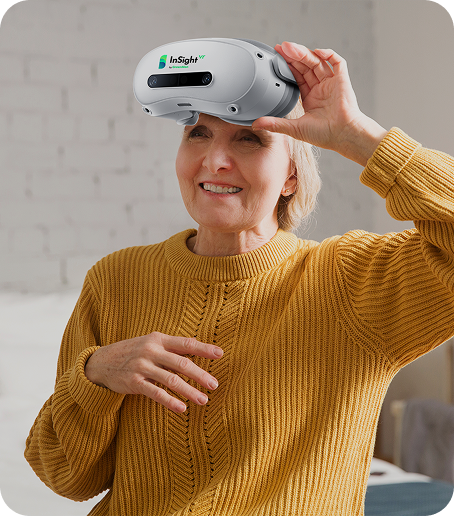
InSightVR by GreenMan offers a unique experience for any clinical setting. With a plug and play mentality, it can be catered to your existing workflow to best suit the individual needs of your clinic, team, and patients.
A few of the methods in practice across the country in order of most implemented
- At the end of the technician led workup
- Before dilation
- Experience led by technician
- After the doctor evaluation
- After dilation
- Experience led by technician or surgical coordinator
- A second clinic visit
- Not dilated
- Experience led by technician or surgical coordinator
End of Technician Workup
Most commonly, we see InSightVR implemented at the end of the cataract workup and prior to dilation.
Ophthalmic Technicians guide their patient through the experience at any point the team sees fit as long as it is after the testing for the biometry reading for the residual corneal astigmatism and refraction for best corrected vision. Remember we will use that refraction for placing loose lenses to allow for best corrected vision inside the headset.
With this method there are two options as far as team members guiding patients through the InSightVR experience.
- All technicians are trained
- Special testing technicians are trained
Placing InSightVR at the end of the work up means that the team member responsible for guiding the patient through the experience will need to educate the patient that while they will show them the options for every IOL type available, the patient may not be a candidate for each option. The doctor will confirm candidacy for individual IOL types during their exam.
Additionally, if the implemented workflow is at the end of the technician work up, the patient could receive dilation drops immediately before starting the InSightVR experience. A typical time spent inside the headset is anywhere from 3-7 minutes. Dilation drops administered right before the experience would not likely have the time necessary to impact vision enough to diminish the education. In this way, the 10-15 minutes typically spent allowing dilation to occur is spent in action, eliminating the perceived wait time.
After Doctor Evaluation
Alternatively, InSightVR can take place after the doctor completes their visit.
With this workflow method, there two choices as far as which IOLs to present on:
- All IOLs offered by the clinic with specific details on those the patient is not a candidate for
- Only the IOLs recommended by the doctor
We recommend educating the patient on all IOLs offered. This allows for a consistent education across all patients. If the doctor does not recommend a specific IOL for a patient, this allows for the opportunity to confirm that the patient understands why a specific lens is not a good option for them to pursue. Ensuring that they understand what the doctor explained and once again, aligning expectations.
The biggest change to this approach is to consider the patient’s vision with dilation. As the patient is fully dilated for the doctor’s exam, this dilation will impact vision inside the headset. However, even with dilation altering the patients vision, patients are able to appreciate the changes to vision when shown the different IOL options. Reminding the patient that the vision they experience in the headset is not the vision they are signing up for with surgery is very important. The goal of patient education: to see those differences in the different IOL options available, is still achieved.
Another Day Entirely
Some clinics may choose to have the patient return for another visit to experience the InSightVR patient education program.
This workflow method works well for clinics who are looking to make as minimal change to their existing workflow as possible. With this option, patients have their initial evaluation, exam with the doctor, may visit with a surgical coordinator to schedule surgery and to wrap up the visit. Before leaving the patient would schedule a return visit for the InSightVR experience. This allows for the doctor to present the options the patient is a true candidate for, gives the patient time to consider these options and discuss with loved ones, and for the patient to experience the InSightVR program without dilation to finalize their IOL decision.
Additionally it does allow clinics to plan for an InSightVR clinic day. Patients may be scheduled in volumes to allow a team member to be a point person and guide a stacked schedule of patients through the experience. Planning a day for specific use may be helpful for smaller clinics.
The biggest challenge to this method is to add another appointment to the process. This may work well in larger populated cities where patients don’t have far to travel to their doctors appointment. However, in rural areas where it is common for patients to travel a few hours for each appointment, we don’t recommend this workflow method.
Overall, there seems to be endless opportunities to implement InSightVR education to your patient experience. Perhaps your team is considering another workflow process not included in this article?
The team at GreenMan would enjoy hearing from you. Contact us with your implementation ideas and questions here.